Surfnerd Logo

Surf forecast for Hollyoake

Tide
โฑ๏ธs.
โšก๏ธkJ
Timezone:
America/New_York
Forecast updated:
20/06, 08:00
Wind: SN UNITY Atmos
(20260620 00z)
Waves: SN UNITY WAVE
(20260620 00z)
Join Surfnerd to check this forecast
Create a free account to check forecasts, set your home spot, save spots and log surf sessions.
Sign up with AppleSign up with Google

Timeline

Sun 21/06
No surf windows
Unlock 3 more days in the timeline
More surf windows and day entries continue below

Hollyoake Surf Forecast Guide

Hollyoake is a surf spot that caters mainly to intermediate surfers looking for some fun. Located near the beach with a sandy bottom, it can offer decent waves when the conditions are right. Parking is limited on the roadside, and you might find the police patrolling the area, so keep an eye on your car. Lifeguards are around but are pretty chill, often hitting the waves themselves.

The surf at Hollyoake is best with a northeast swell, where you can expect long, punchy lefts that can be hollow on take-off and provide some fun sections down the line. When the wave hits, it can handle swell sizes around 2 feet (about 0.6 meters). A south or southeast swell tends to close out, so try to stick to that northeast direction. For optimal conditions, low to mid tide is where itโ€™s at, and if the wind is coming from the west, it helps to clean things up. The north-to-south drift can be strong, so be prepared for some paddling to stay in that tight take-off area. Some surfers enter on the north side of the jetty and walk back for their next ride, which can help ease the crowded vibe that sometimes comes from the local regulars.

If you're planning a trip, be aware that the wave rides are best suited for intermediate surfers. This spot can get crowded, especially with locals dialed in, so a friendly approach goes a long way. Overall, it's a decent place to catch some waves, just make sure to be mindful of the conditions!

Surf spots near Hollyoake

Wooden Jetties
New Jersey, United States
Unknown break
Sat 20
Sun 21
Mon 22
Tue 23
Wed 24
Hollyoake
New Jersey, United States
Unknown break
Sat 20
Sun 21
Mon 22
Tue 23
Wed 24
Holyoke
New Jersey, United States
Beach break, Jetty break
Sat 20
Sun 21
Mon 22
Tue 23
Wed 24
Beach Haven
New Jersey, United States
Unknown break
Sat 20
Sun 21
Mon 22
Tue 23
Wed 24
Long Beach Township
New Jersey, United States
Unknown break
Sat 20
Sun 21
Mon 22
Tue 23
Wed 24

Frequently asked questions

What are good surfing conditions for Hollyoake?

Hollyoake is usually best with swell from northeast through east-southeast to south (NE-ESE-S), ideally northeast (NE) around 0.6 m / 2 ft to 3.7 m / 12 ft, west (W) offshore wind, and low to mid tide.

Where is the surf spot Hollyoake?

Hollyoake is a surf spot in Long Beach, New Jersey, United States.

What is the surf break like at Hollyoake?

Waves at Hollyoake break left. Hollyoake breaks over sand. Expect a busy crowd.

What surfing skill level is Hollyoake suitable for?

Hollyoake can suit intermediate surfers.

Is Hollyoake beginner friendly for surfing?

Hollyoake is better suited to intermediate surfers.

How consistent is the surf at Hollyoake?

Hollyoake is one of the more consistent surf spots in New Jersey, United States.

What facilities are available for surfers at Hollyoake?

Facilities for surfers at Hollyoake: lifeguard and surf shop.

Is there parking for surfing at Hollyoake?

Parking around Hollyoake: free parking, paid parking, roadside parking, and restricted parking.

What surf spots are near Hollyoake?

Other nearby surf spots are Holyoke, Beach Haven, Wooden Jetties, and Long Beach Township.

What swell direction works for surfing at Hollyoake?

Hollyoake can work with swell from northeast through east-southeast to south (NE-ESE-S); northeast (NE) is usually best.

What swell size works for surfing at Hollyoake?

Hollyoake usually works with swell around 0.6 m / 2 ft to 3.7 m / 12 ft.

What wind direction is best for surfing at Hollyoake?

West (W) offshore wind is usually best at Hollyoake.

What wind direction is offshore for surfing at Hollyoake?

West (W) is offshore at Hollyoake.

What tide works best for surfing at Hollyoake?

Hollyoake works best around low to mid tide. A rising tide is usually better here.

Join Surfnerd for free
  • Save favorite spots
  • Set home spot
  • Log surf sessions
Sign up with AppleSign up with Google
Share
Surfnerd Logo

Login to your Surfnerd account

Log your sessions, save your favorite spots, and keep your surf forecast personalized.

Log in with AppleLog in with Google
Surfnerd Logo
Never miss a good surf again
  • See what's coming the next 15 days
    Plan ahead so you know which days to keep free.
  • Know the power of the waves
    Wave energy shows you what the wave actually feels like.
  • See every swell hitting your spot
    Know when swells combine for better waves, or when a cross-swell messes things up.
  • Trust the forecast before you commit.
    Compare multiple models to know when conditions are locked in.
Cancel anytime. Automatically renewed until cancelled
By purchasing the product, you accept the Terms of Use & acknowledge the Privacy policy.

Open in the app

Scan the QR code to open the Surfnerd app

Readme

Welcome! If youโ€™re new to surf forecasting, check out this quick guide.

Forecast Table

The forecast table (the section on the page with all the numbers) is designed to pack as much information in the screen as possible. Although intimidating at first, it will help you make informed decisions about the waves faster, trust me :D. The table consists of roughly four sections, time and predictions, wind, waves, and tides:

๐Ÿ”ฎ Time and predictions section

Here we show the forecast thour and the overall surf quality prediction. This is determined based on the wave, wind and tide quality prediction. These individual predictions can be found on the forecast map.

๐Ÿ’จ Wind section

The first row on the table (with the ๐Ÿ’จ icon) shows wind speed, direction and gust. The more the wind speed the more aggressive the color (from blue, green, orange to red).

๐ŸŒŠ Wave section

The waves section consists of three rows, one for wave height and direction, one for period and one for wave energy. Our algorithm chooses the "dominant wave" using spot-adjusted surf energy (depth + directional fit). This is usually the first swell partition, but during local storms it can switch to wind waves. If that happens, values are shown in gray and italic.

๐ŸŒ’ Tide section

The tide section consists of a row with the actual heights per hour (measured at the half hour) and a table that displays the flow of the tide and the extremes (lows and highs).

Forecast map

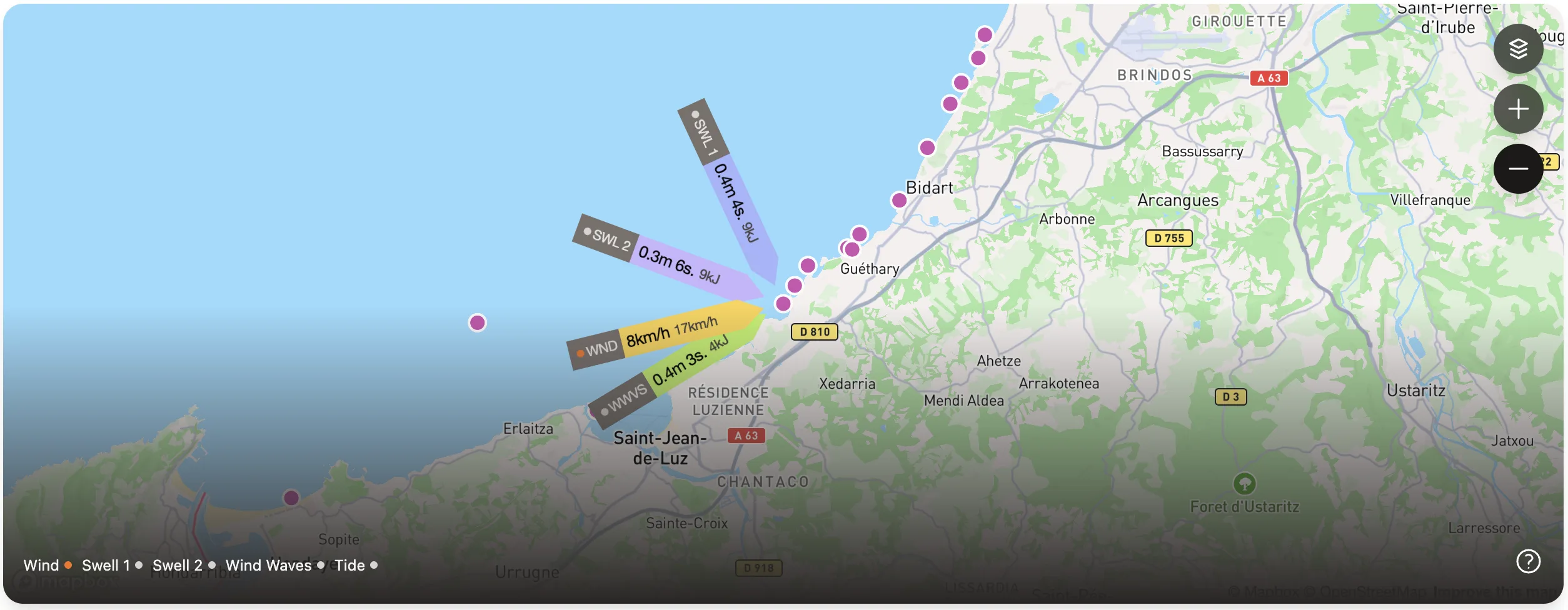
The forecast map consists of arrows. These arrows represent all wave partitions (swell partitions and wind wave partition) and the wind. This allows you to see things like: a secondary swell or wind waves messes up the surf, or the wind is just a tick offshore so very surfable. Click a metric label in the bottom left to bring that arrow to the front โ€” handy when arrows overlap.

Forecast Cheat Sheet

Short on time? Focus on wave energy. Itโ€™s the best single metric to gauge how big and powerful the waves will be.

Click any table cell to jump to that forecast hour. The map will update with forecast arrows, so you can see if wind and swell direction are lining up.

Use the table sidebar to switch units for height and speed.

Log your surf sessions to compare forecasts with real sessions and sharpen future predictions.

Models and Updates

Surfnerd blends multiple global and local wind and swell models using advanced interpolation and spatial techniques to create an "ensemble" forecast. Forecasts are refreshed hourly.

Surf Predictions

Our AI-driven algorithm scores surf quality, shown by green, orange, and gray dots. Each forecast hour is rated for wind, swell, and tide quality, then combined into an overall score. Hereโ€™s the scale:

Perfect
Good
Average
Bad or No Data

Session logs also feed the algorithm โ€” the more you log, the smarter your forecasts get.

With Surfnerd, no more "you should have been here yesterday"

Confidence

Confidence tells you how much the weather models agree on the forecast.

  • High confidence: Models agree closely; forecast is reliable.
  • Medium confidence: Some disagreement; conditions may shift slightly.
  • Low confidence: Models diverge; treat forecast with caution.

We calculate the wind confidence by comparing wind speed, gust and direction from multiple models (like GFS, ECMWF, Arome, and Harmonie) and seeing how closely they match. For wave certainty we compare height, period and direction, also on multiple models. They are weighted, meaning that some models count more than others, depending on how good they are for a certain spot.