
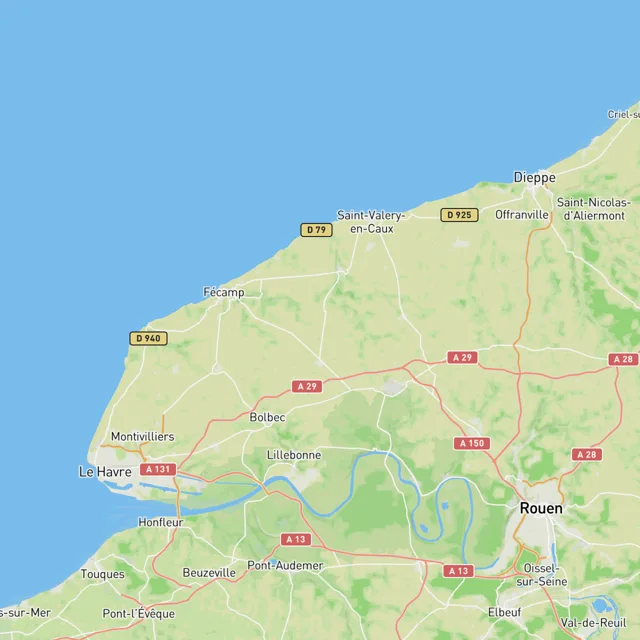

Seine-Maritime runs along the chalk-cliff coast of Normandy, where the English Channel narrows and the surf leans on a solid north-through-west swell pushing down toward the shore. This is Channel surfing rather than open-Atlantic beach break territory: the waves need the right storm angle to wrap in, so good days arrive in windows rather than on demand. When a low sends northerly to westerly swell across the Channel with enough size and period, the region's beaches and its lone reef start to come alive.
Most of the surfing in Seine-Maritime happens on beach breaks, several fronted by boulders and shingle rather than clean sand, with a few sandy sections and one rock-ledge setup mixed in. Notable spots include Dieppe, Etretat, and Petites Dalles, spread between Le Havre toward the southern end and the smaller cliff-foot villages of Sassetot-le-Mauconduit and Vattetot-sur-Mer further up the coast. Etretat is famous for its dramatic arches and needle, and its steep pebble beach captures how much of this shoreline trades easy sand entries for character.
The swell window is wide, opening to anything from north and northeast around to west and west-northwest, but in practice it wants real size and a decent period to bend into the Channel. Spots begin working from around 1 ft, and the beaches can hold up to roughly 8 ft before they turn unruly, while the more sheltered corners top out a touch smaller near 6 ft. Offshore winds blow off the land, mostly from the southeast with some south, so a light southeasterly is the classic clean-up breeze for the beaches; the reef prefers a southwesterly. Mid tide is the dependable stage across the region, with several spots also holding through the high and only a corner or two favoring low.
For ability, this is a welcoming stretch to learn. A little over half the spots suit beginners, while the rest give intermediates more to work with once the swell fills in. Dieppe and the gentler beach setups are natural places to start, and the reef and punchier beaches reward surfers who can read a shifting Channel peak.
The practical read is simple: watch for a north-to-west groundswell with enough size and period, pair it with a light southeast wind and a mid tide, and Seine-Maritime turns from flat to fun. Miss the swell angle and it can sit quiet, which is why checking the forecast and keeping two or three of these spots in your back pocket pays off more here than on a consistent Atlantic beach.