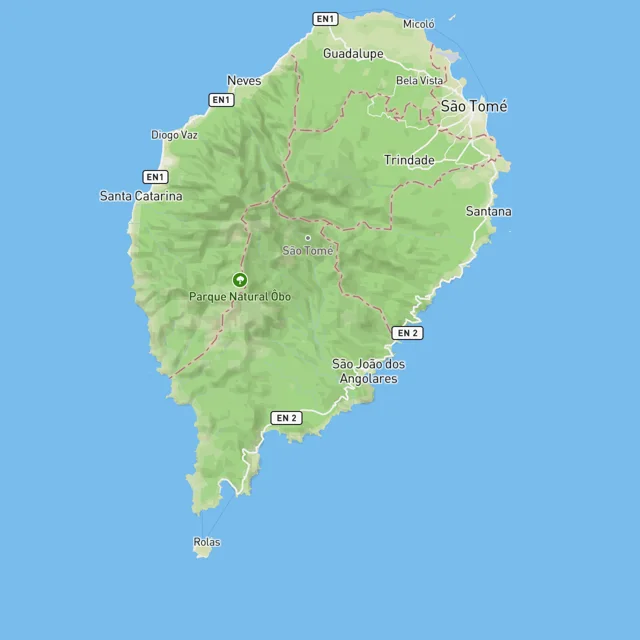

São Tomé Island sits in the Gulf of Guinea off Central Africa, and its surf runs almost entirely on southern swell wrapping into a string of points, reefs, and river mouths along the coast. The best days come from south through southwest groundswell, and a light westerly wind tends to clean up the faces. Most breaks stay rideable across low and mid tide, and many hold into high tide too, so reading the specific break matters more than chasing a narrow window.
The heart of the scene is around São Tomé town, with more spots strung south toward Porto Alegre and pockets near Ubabudo and Agua Ize. Points are the signature setup here: over half the island's waves break off boulder points, giving long, predictable walls when the swell lines up from the south. Notable spots include Agua Ize, Baia Coqueiro, and Batismo, a good starting point for understanding how this coastline bends swell into makeable shape.
Break variety splits fairly cleanly by ability. The boulder points are mostly intermediate terrain, rewarding surfers who can read a longer wall and handle a rocky bottom. The reefs are the island's expert corner, breaking over uneven reef and rock ledge and asking for confidence in both the takeoff and the exit. Beginners have the fewest options, but the river mouths and the lone beach break offer gentler, sand-influenced waves that make more sense while you find your feet.
Swell size needs are modest. Most spots want at least waist-to-chest-high surf to start working, a couple come alive on knee-high days, and the upper end runs from head-high on the softer points to well overhead on the standout reef when a bigger south pulse arrives. That range keeps the island approachable on average days while still holding size for the rare larger swell.
For surfing in São Tomé Island, the planning is straightforward: watch for south to southwest swell, hope for a westerly offshore, and pick your tide by the break. Points and river mouths are the flexible, all-tide choices, while the reefs reward a more deliberate window and a higher skill level. Because this is an equatorial island rather than a reliable swell magnet, patience pays off, and the payoff is warm-water waves in a genuinely remote corner of the surfing world.