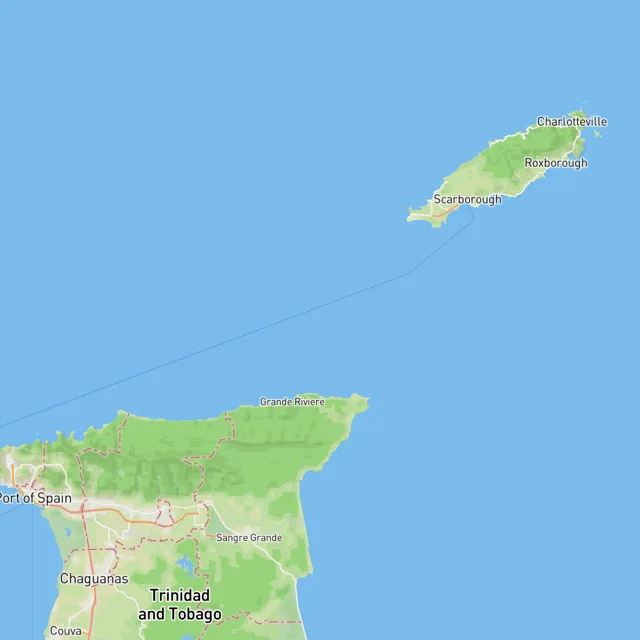

Surfing in Trinidad and Tobago centers on two very different islands: Trinidad's rugged northeast and north coasts, and the reef-lined shores of Tobago. Across the country the swell window faces the open Atlantic, so most breaks come alive on northeast swell, with north, north-northeast, east-northeast, and east angles also feeding the coast. Waves commonly break in the waist- to head-high range, though a handful of spots can hold size when a bigger pulse arrives.
On Trinidad, the Sangre Grande region gathers the most surf around the northeastern point, with breaks near towns like Rampanalgas, L'Anse Noire, Petit Trou, and Toco (Balandra, Sans Souci, Salybia Bay, Toco). Further along the north coast, quieter areas add single beach breaks such as Blanchisseuse and Las Cuevas near Maracas Bay Village. These are narrow local examples rather than a continuous coastline, so treat each as its own setup.
Tobago splits into a reef-heavy west and a smaller east. Western Tobago is almost entirely reef, with breaks around Grange and Bon Accord such as Mount Irvine, Sunset Left, and Airports; these favor north through northeast swell and light southeast wind. Eastern Tobago, around Richmond, offers a couple of options including Crazy's and South Coast.
Winds out of the south and southeast tend to clean up the most breaks, and many spots stay rideable across low, mid, and high tide, so timing is often more about swell and wind than the tide clock. The most active stretches lean toward autumn and winter. Conditions suit intermediates best overall, with a few beginner-friendly beaches and a couple of expert-only reefs mixed in. As always, compare swell, wind, tide, season, and each spot's character before you paddle out.