
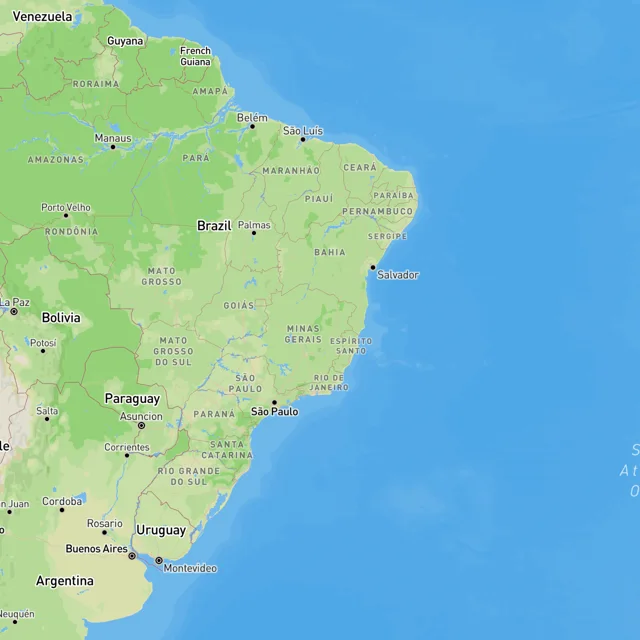

Surfing in Brazil centers on a long Atlantic coastline where sand-bottomed beach breaks dominate, with spots spread across many regions from the far south up to the northeast. Most of the country's surf sits along the southeast and south, where swell tends to arrive from the south, southeast, and east, and beach breaks over sand are by far the most common setup.
Rio de Janeiro, Santa Catarina, and Sao Paulo hold the densest concentrations. Around Rio de Janeiro you'll find beach breaks like Grumari, Barra da Tijuca, and Prainha, along with Saquarema further along the coast. Santa Catarina spreads its surf across many small towns, with spots such as Joaquina near Lagoa da Conceição, Guarda do Embau at Paulo Lopes, and Ferrugem near Garopaba. Sao Paulo's coast includes Maresias, Camburi, and Pitangueiras near Guaruja. Just north, Espirito Santo adds beach and occasional reef options around Jucu, Guarapari, and Regência.
The far south, in Rio Grande do Sul, is almost entirely sandy beach break and leans strongly beginner-friendly, with spots like Cidreira and Atlântida Pier working across most of the tide and picking up east and south swell.
Brazil's northeast sits apart from this southern pattern and behaves differently. These coasts face more north and northeast swell and mix reef in among the beaches. Bahia has points and beaches around Itacaré and Ilhéus, including Tiririca and Norte. Pernambuco leans toward reef and more demanding waves at spots like Cupe near Porto de Galinhas, Maracaipe, and Cacimba do Padre on Fernando de Noronha. Ceará adds sand-bottom beaches and points around Fortaleza, Caucaia, and Taíba.
Because setups vary so much between the south and the northeast, it helps to match your session to each spot. Compare swell direction and size, wind, tide, and season against a spot's own characteristics rather than assuming one rule fits the whole coast. Many spots work through mid, low, and high tide, which gives a wide daily window, though the best wind and swell angle differ from region to region.
For boards, a shortboard covers most conditions, while the abundance of gentle beach breaks, especially in Santa Catarina and Rio Grande do Sul, makes Brazil a comfortable place for beginners and improvers. The more powerful reef and point setups in the northeast reward stronger surfers. Whatever your level, checking the forecast for swell, wind, tide, and season alongside the local layout is the best way to choose where to paddle out.